Key Takeaways
- Rehabilitation is a progressive process that requires consistent, daily dedication.
- Managing swelling through elevation and cold therapy is critical in the early phases.
- Gradually increasing range of motion and muscle strength stabilizes the joint.
- Pacing your activities helps prevent inflammation flares during recovery.
- Regular guidance from a physical therapist keeps your rehabilitation pathway safe.
The Fundamentals of Knee Rehabilitation
Rehabilitation is the cornerstone of recovery after any knee injury or surgical procedure. Whether you are recovering from an ACL reconstruction, meniscus surgery, or a knee replacement, the recovery process follows a structured, progressive pathway.
The primary goal of rehabilitation is to restore joint mobility, rebuild muscle support, and regain full functional confidence. In the early stages, the focus is entirely on protecting the healing tissues, managing swelling, and gently restoring movement. As you progress, the program shifts toward building strength, balance, and endurance.
"Successful knee rehabilitation is a recovery process that requires consistency, patience, and listening to your body to achieve long-term joint health."
Phase 1: Swelling Control and Early Range of Motion
Directly following surgery or injury, inflammation is your body's natural response. However, excessive swelling acts like a mechanical splint, limiting your range of motion and inhibiting quadriceps muscle function.
To control swelling, prioritize elevation and cold therapy. Elevate your leg above the level of your heart whenever resting, and apply a cold compress for 15 to 20 minutes several times a day. During this phase, focus on gentle range of motion exercises like passive extension (keeping the leg straight) and seated knee bends, staying within a comfortable, pain-free range.
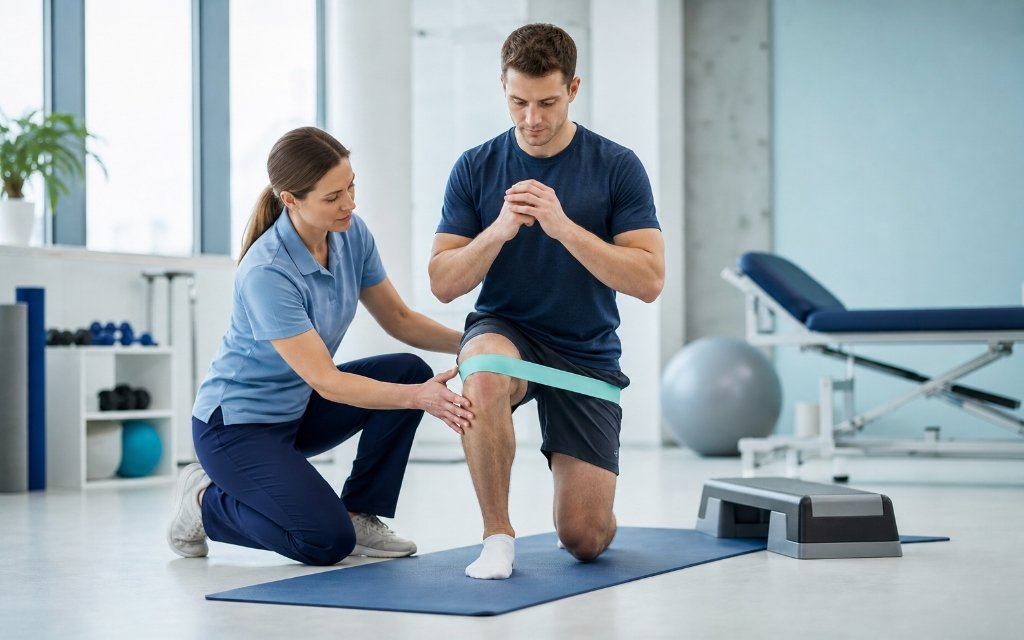
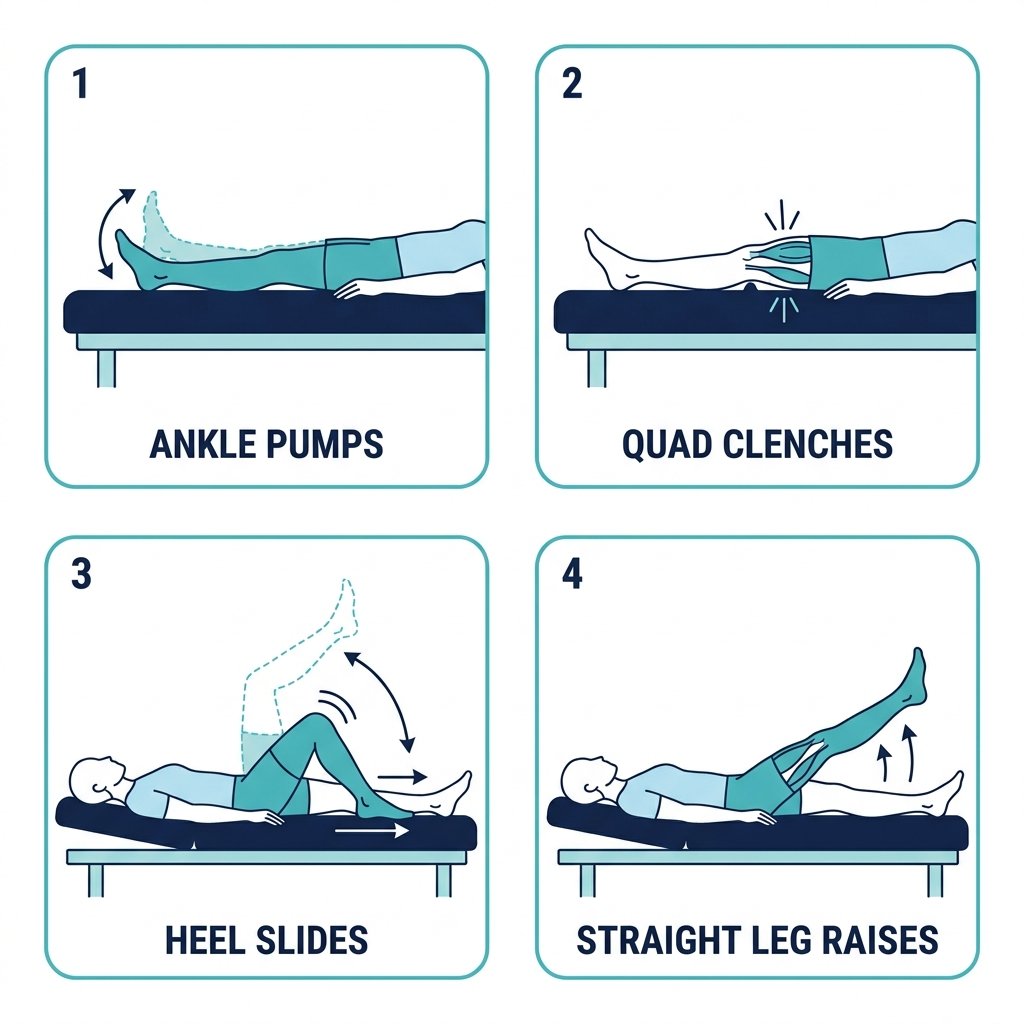
Didactic Exercise Guide: How to Perform Early Movements
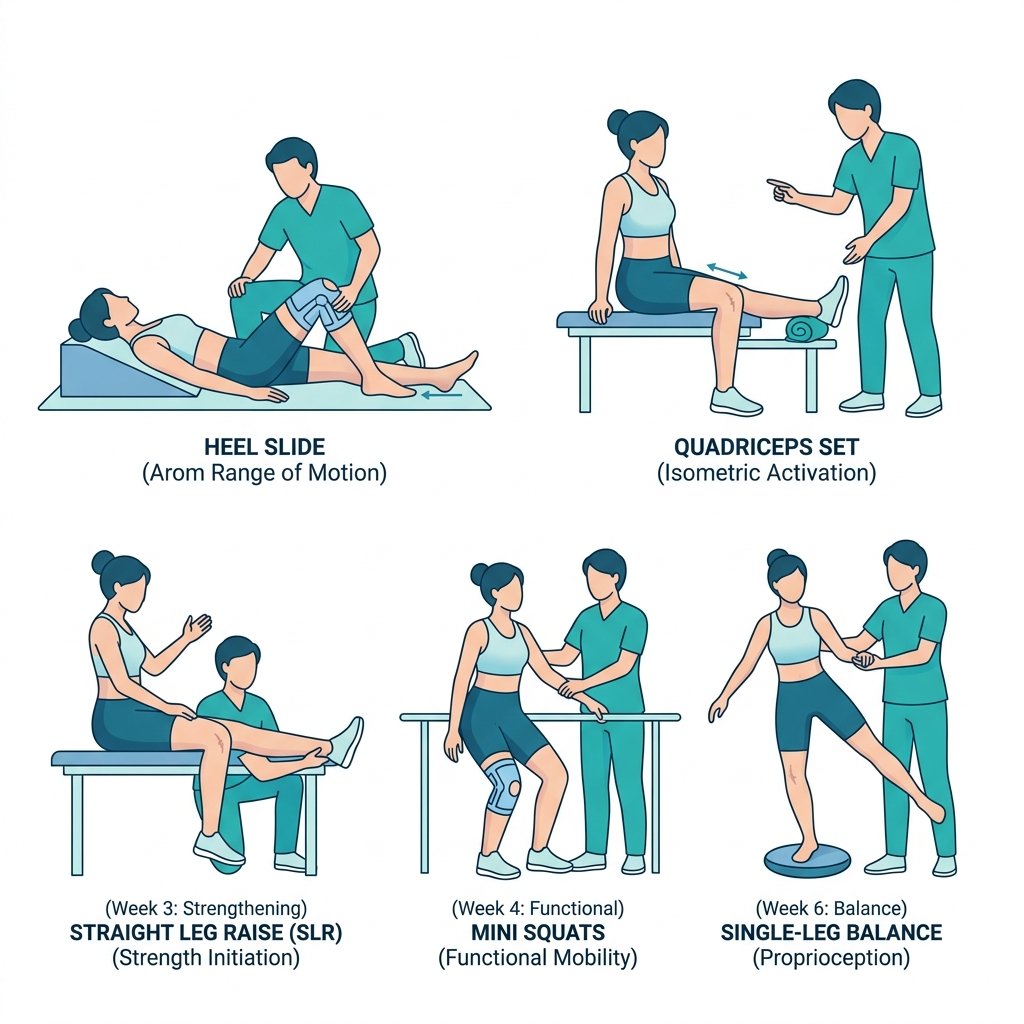
For elderly individuals and patients recovering from recent joint replacement or reconstructive surgery, exercises must be gentle, controlled, and paced. Below are key exercises designed for the early phases of recovery:
- •Ankle Pumps: Lie on your back or sit upright with your legs extended. Smoothly bend your ankles to point your toes away from your body, then pull your toes back up toward your shins. This simple motion stimulates blood flow and reduces lower leg swelling. Aim for 15 to 20 slow repetitions every hour while resting.
- •Quad Clenches (Static Quadriceps): Lie flat on a bed. Push the back of your knee down firmly into the mattress while simultaneously pulling your toes toward your face. This contracts your thigh muscles. Hold the squeeze for 5 seconds, then relax. Aim for 5 to 10 quality repetitions, 2 to 3 times a day. This re-educates the thigh muscle without joint movement.
- •Heel Slides: Lie on your back. Slowly slide your heel toward your buttocks, allowing your knee to bend as far as is comfortable. Use a plastic bag or a slide sheet under your heel to reduce friction if needed. Slide your heel back out. Stop when you feel a mild stretch, never bending through sharp pain. Aim for 5 to 8 slow repetitions, 2 times a day.
- •Straight Leg Raises: Lie flat on a bed. Bend your non-operated knee, placing that foot flat. Keep your operated leg completely straight, tighten your thigh muscle (perform a quad clench), and slowly lift the leg 6 to 8 inches off the bed. Hold for 2 to 3 seconds, then lower it slowly under control. If you cannot lift the leg without the knee bending, pause this exercise and focus on quad clenches first. Aim for 5 to 8 repetitions, 1 to 2 times a day.
Phase 2: Progressive Muscle Activation and Strengthening
Once swelling starts to settle, the focus shifts to muscle activation. The quadriceps muscle on the front of your thigh is the main stabilizer of your kneecap and joint, and it often weakens quickly after injury.
As your strength improves, functional movements such as wall squats and step-ups are introduced to rebuild your movement patterns. Perform these exercises slowly and with control, emphasizing correct alignment of the hip, knee, and ankle.
Phase 3: Balance, Proprioception, and Functional Recovery
The final stage of rehabilitation prepares your knee for everyday life, work, and sports. This phase focuses on balance (proprioception) and coordination.
Exercises like standing on one leg, using a wobble board, and performing gentle lunges train the nerves around your joint to react quickly to changes in position. This dynamic stability is what protects your knee from future slips, twists, or falls. Gradually return to walking longer distances and low-impact cardiovascular training.